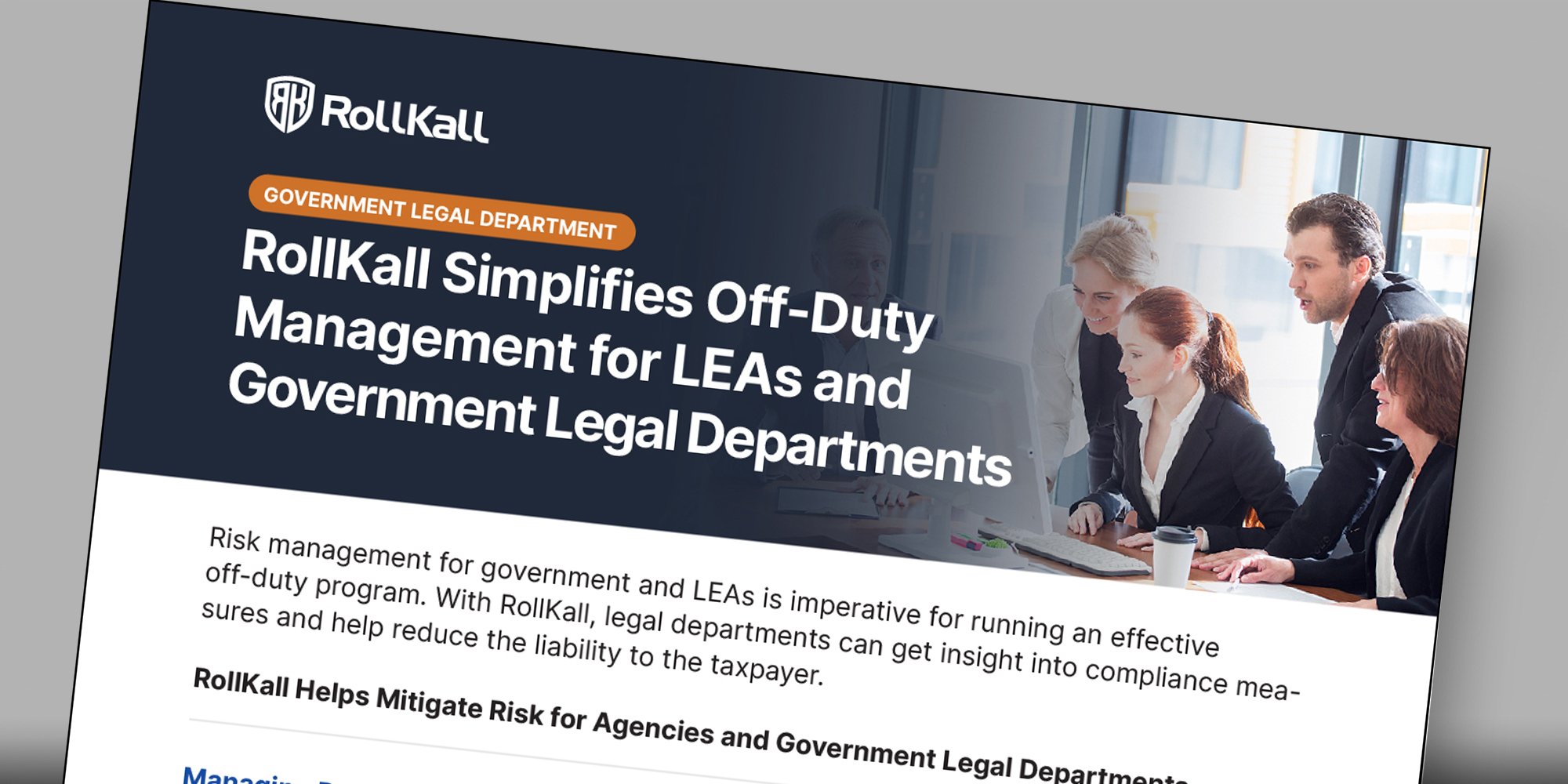
Off-duty and secondary employment are not new to policing, but scrutiny around how agencies govern them is rising. This post offers a practical modernization framework built on three non-negotiables: transparency, agency-led control, and independence by design. Through a realistic leadership scenario, it shows why off-duty governance must be defensible, scalable, and audit-ready to protect officers and agencies. It also includes a one-page checklist.
Off-duty and secondary employment have always been part of policing. Communities need extra coverage. Officers value the supplemental income. And agencies have long relied on a mix of policies, manual workflows, and legacy processes to keep the program moving.
But the environment has changed.
Off-duty work is no longer a “back office” administrative function. It’s increasingly a public-facing governance issue- one that can escalate quickly from a routine matter into a leadership-level crisis.
This post offers a practical framework you can take back and use immediately: three non-negotiables that help off-duty programs hold up under scrutiny, scale responsibly, and protect officers and agencies alike.
Recent national reporting has put renewed attention on moonlighting and secondary employment. The takeaway isn’t just that off-duty policies are being examined-it’s that how agencies govern off-duty work is now part of the public conversation.
That shift matters because when scrutiny rises, the questions stop being theoretical. They become operational. Immediate. And public.
Off-duty programs that function “well enough” day-to-day can still be fragile when challenged--especially if policies are vague, enforcement is inconsistent, or documentation and audit trails are hard to produce quickly.
Picture a scene that feels uncomfortably familiar.
It’s 6:30 a.m. Your phone rings. It’s not your watch commander-it’s your city manager.
“Chief, have you seen the video?”
A clip is circulating online. The story is moving fast. Maybe it shows an officer in a marked unit appearing to be asleep. Maybe it’s an incident at a job site. Maybe it’s something that looks minor until it’s not.
Here’s the part that matters: the first question you get is rarely, “Is this officer a good cop?”
The first question is:
“Chief, what is the system that allowed this?”
Then come the rapid-fire questions you already know are coming:
That’s the nightmare scenario. Not because an incident occurred--incidents happen in policing.
It’s the nightmare because the next hour isn’t about the officer.
The next hour is about governance.
Here’s the punchline:
“If you can’t explain it fast, you don’t control it.”
And if you don’t control it, you’ll be asked to defend it--in public.
When governance is strong, leaders can answer quickly, accurately, and confidently. When governance is weak, leaders spend critical hours reconstructing facts, interpreting unclear policies, and scrambling for documentation, while the narrative runs ahead.
So how do you prevent that call?
You modernize off-duty like the program you’re accountable for.
Modernization doesn’t mean “more technology.” It means designing a program that’s visible, documented, defensible, and scalable.
These are the three non-negotiables.
Transparency is the antidote to uncertainty.
Chiefs need financial, legal, and operational visibility-not just for internal management, but to answer governance questions quickly when they arise.
Transparency means:
If you can’t see it clearly, you can’t govern it confidently.
Off-duty must remain agency-led.
That means the agency sets policy, approves jobs, and retains oversight-period.
Programs become fragile under scrutiny when workflows are opaque, inconsistent, or effectively controlled outside the agency. Even if things “work” day-to-day, a system that can’t show clear agency control becomes hard to defend when questions surface.
Control belongs with the agency because accountability does.
This one matters in places where 1099 structures are common.
The risk isn’t “using a 1099 model.”
The risk is when a system drifts into employer-like control in practice-even if no one intended it.
Independence doesn’t fail on paper. It fails operationally-through convenience, habit, or systems that quietly start behaving like payroll instead of governance.
A simple test:
If a neutral third party reviewed how your off-duty program actually operates on its worst day,would it look like independent work, or employer control in practice?
When independence is intentional-designed, not assumed-you reduce classification exposure, protect officers, and keep the agency on solid ground when questions come.
The target isn’t less oversight. The target is governed autonomy: clear agency policy, real visibility, and independence that holds up under scrutiny.
When these three non-negotiables are in place-transparency, agency-led governance, and independence by design-off-duty modernization starts to deliver outcomes that matter:
It becomes easier to manage the program proactively instead of reacting under pressure.
Scrutiny is rising, and off-duty governance is now a national conversation. Agencies that thrive will treat off-duty as a governed program that is visible, documented, defensible, and modern.
If you take one action after your next leadership meeting or conference, launch a modernization initiative and make these three items your non-negotiables.
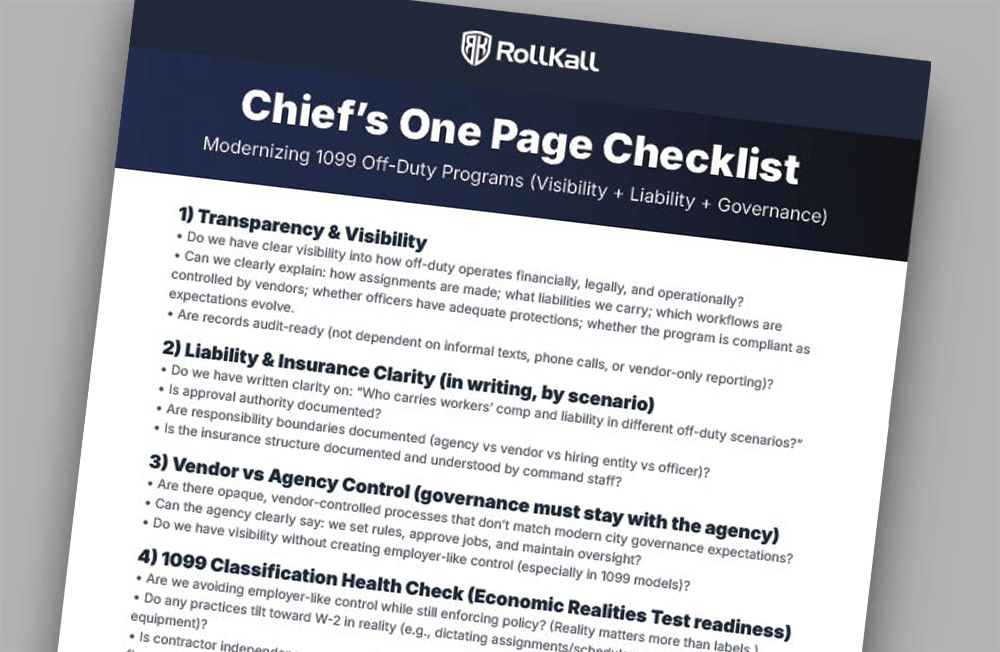
One simple way to start is to use a one-page checklist your command staff can review on Monday to assess where your program is strong, where it is exposed, and what to prioritize next.
Get the checklist now: complete the form below. After you submit, you will be redirected to the checklist page immediately.
A 30-minute demonstration walks through the full platform: scheduling, finance integration, payments at scale, and the operating models behind it.
Dedicated to first responders, RollKall simplifies every aspect of vendor-paid details.